
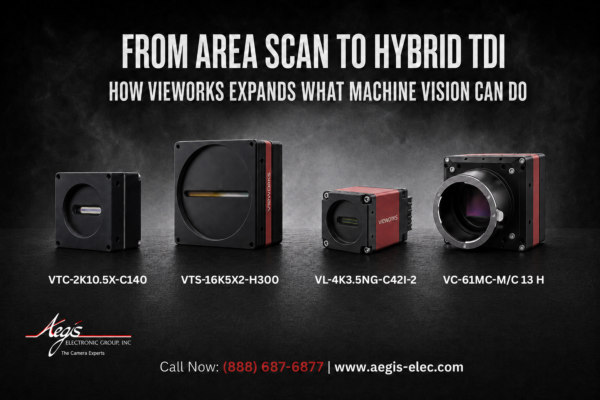
Vieworks industrial cameras give machine vision engineers more ways to balance resolution, speed, sensitivity and system integration. The portfolio spans compact VGA-resolution models through ultra-high-resolution cameras offering up to 288MP. From compact area scan models to high-speed line scan cameras and advanced hybrid TDI systems, Vieworks addresses inspection challenges that conventional cameras may not handle effectively.
An industrial camera can have an impressive megapixel count and still be completely wrong for the job. It may capture plenty of detail but lack the speed to keep pace with production. Another camera may freeze fast-moving objects but struggle to reveal faint defects in limited light. Even the right sensor can create problems if its interface cannot support the required bandwidth, cable distance or triggering accuracy.
The most demanding machine vision projects are rarely solved by choosing the camera with the largest number on its datasheet. They require the right combination of resolution, speed, sensitivity, optical format, data transfer and system complexity. That breadth is what distinguishes Vieworks industrial cameras from more narrowly focused product lines.
Why Vieworks Industrial Cameras Cover More Applications
Vieworks does not force every inspection problem into the same camera architecture.
A compact camera that works perfectly for component verification may be unsuitable for semiconductor inspection. A high-resolution area scan camera can capture a large object in extraordinary detail but may be the wrong choice for inspecting a continuous roll of film. A conventional line scan camera may keep pace with moving material yet lack the sensitivity needed to reveal low-contrast defects.
The Vieworks portfolio addresses these different requirements through four principal camera categories:
- Area scan cameras
- Conventional line scan cameras
- Monochrome TDI line scan cameras
- Color TDI line scan cameras
Across these categories, engineers can select from monochrome, color, NIR and polarization-sensitive configurations. Available interfaces include GigE, 5GigE, 10GigE, USB3, Camera Link, CoaXPress and CoaXPress-over-Fiber.
Not every model includes every capability, nor should it. The advantage is having enough architectural choices to select the right combination for the inspection instead of paying for features the application does not require.
How Vieworks Industrial Cameras Balance Resolution and Speed
Area scan cameras capture a complete two-dimensional image in a single exposure. They are widely used for robotic inspection, dimensional measurement, component verification, metrology and applications in which the entire target must be analyzed at once.
The challenge is that higher resolution produces more data. Transferring more data generally requires either a lower frame rate or a faster interface. Vieworks industrial cameras address both sides of that equation with models ranging from compact GigE and USB3 cameras to high-bandwidth CoaXPress 2.0 systems.
Compact VZ Series cameras provide practical connectivity for conventional inspection stations. Available configurations include monochrome, color, NIR and polarization-sensitive imaging, giving integrators options for presence detection, measurement, surface inspection, robotic guidance and material analysis.
For applications with much greater bandwidth requirements, Vieworks offers Camera Link, 10GigE, CoaXPress and CoaXPress 2.0 cameras.
The differences can be substantial. The VC-21MDF-M/C460 I combines 5120 × 4096 resolution with frame rates exceeding 450 fps. The VC-65MX2-M/C71 I captures approximately 65-megapixel images at more than 70 fps. The VC-127MX2-M/C21 H pushes resolution to approximately 127 megapixels while still delivering roughly 21.9 fps.
These specifications serve a practical purpose: detecting smaller defects across larger components without reducing inspection speed to an unacceptable level.
That combination is particularly valuable for semiconductor inspection, electronics manufacturing, advanced metrology and large-component inspection. High-bandwidth CXP-12 models make it possible to transfer these large images at speeds suitable for demanding production environments.
What Happens When 127 Megapixels Is Not Enough?
Some applications require more spatial detail than a conventional sensor can provide. Vieworks answers that challenge with precision pixel-shifting technology.
Instead of relying on one exposure, the camera moves its sensor through precisely controlled sub-pixel positions. Multiple exposures collect slightly different spatial information and are then combined into one extremely high-resolution image.
The Vieworks VNP Series uses this technique to reach resolutions that would otherwise require an enormous—and potentially impractical—native sensor.
For example:
- The VNP-576MX2-M15 begins with a native 12000 × 12000 image and produces an extended 24000 × 24000 image, or approximately 576 megapixels.
- The VNP-604MX expands an approximately 151-megapixel native image to roughly 604 megapixels.
- The VNP-1152MX2-M15 extends its 24000 × 12000 native resolution to 48000 × 24000—approximately 1152 megapixels.
These are extended pixel-shift resolutions rather than images captured in one exposure. That distinction is important. Pixel shifting is best suited for stationary or carefully controlled targets, not objects moving rapidly through a production line.
For the right application, however, it can reveal minute features across an extremely large field of view. Potential uses include flat-panel display inspection, semiconductor analysis, document digitization, scientific imaging and other applications where maximum detail matters more than freezing high-speed motion.
Supported VNP cameras also use thermoelectric cooling to lower sensor temperature by as much as 20°C below ambient conditions. This helps reduce thermal noise and stabilize image quality during long exposures. The result is not merely a larger image—it is a cleaner and more useful inspection image.
Hybrid TDI: More Light Without Slowing the Line
Continuous materials create a different imaging problem.
Line scan cameras construct an image one line at a time as the target moves past the sensor. This makes them ideal for inspecting paper, film, foil, textiles, glass, printed materials and other continuous or elongated targets.
As production speed increases, however, the available exposure time for each line decreases. Less exposure means less light, and low-contrast defects can disappear into image noise.
Time Delay Integration, or TDI, addresses this problem by imaging the same point across multiple sensor stages. The signals are accumulated as the target moves, increasing sensitivity without requiring the production line to slow down.
Within the broader selection of Vieworks industrial cameras, TDI models provide a specialized solution for high-speed inspection under limited-light conditions.
Vieworks’ hybrid TDI architecture combines a CCD-based TDI pixel array with CMOS readout electronics. It is designed to retain the sensitivity, dynamic range and low-noise signal accumulation associated with CCD TDI while gaining the faster readout and lower power requirements of CMOS technology.
Standard VT Series configurations offer multiple resolutions, pixel sizes, stage counts and interfaces, with supported models offering as many as 256 TDI stages. This allows engineers to balance sensitivity, speed and spatial resolution around the actual material, production rate and defect being inspected.
Typical applications include:
- Semiconductor and wafer inspection
- Flat-panel display and glass inspection
- Printed circuit board inspection
- Film, foil, paper and web inspection
- Textile and print inspection
- Food sorting and packaging inspection
- High-speed document scanning
Vieworks also offers color TDI cameras. This matters when color variation is part of the defect, including inconsistent printing, discoloration, coating irregularities, textile variations and food-quality differences. Color TDI retains chromatic information while providing greater sensitivity than a conventional color line scan exposure.
BSI TDI for Difficult, Low-Reflectivity Targets
Some materials remain challenging even with conventional TDI. Dark surfaces, low-reflectivity materials and applications involving ultraviolet or near-infrared wavelengths may require another increase in sensitivity.
The Vieworks VT Sense Series uses back-side illuminated TDI sensors to improve quantum efficiency and signal-to-noise performance. Current configurations extend from approximately 4K to 23K resolution, offer as many as 384 TDI stages and reach line rates of approximately 543 kHz.
This combination enables high-speed inspection under limited light while supporting visible, UV and NIR imaging.
Selected models also support CoaXPress-over-Fiber. Fiber connectivity can provide longer transmission distances and greater resistance to electromagnetic interference than conventional copper connections. This can be particularly valuable in large inspection machines, electrically noisy facilities or installations where cameras must be positioned farther from the processing equipment.
Why Vieworks Industrial Cameras Provide More Architectural Choice
The real Vieworks advantage is not one record-setting specification. It is the ability to solve fundamentally different imaging problems.
A compact USB3 camera may be the most efficient choice for a localized inspection station. A high-speed CoaXPress camera may be required to capture rapid production events. A cooled pixel-shift camera may be appropriate for extracting enormous detail from a stationary target. A hybrid TDI camera may be the only practical way to reveal faint defects on material moving at production speed.
The breadth of Vieworks industrial cameras allows engineers to select the camera around the inspection instead of redesigning the inspection around the camera.
Talk to a Technical Expert
Aegis Electronic Group helps customers evaluate resolution, frame or line rate, sensitivity, target motion, pixel size, sensor format, lens coverage, lighting and interface bandwidth together. When a conventional machine vision camera reaches its limits, Vieworks often offers a technology developed specifically for the challenge.
Contact Aegis Electronic Group to identify the Vieworks area scan, line scan or TDI camera best suited to your machine vision system.
[email protected] | (760) 729-2026