
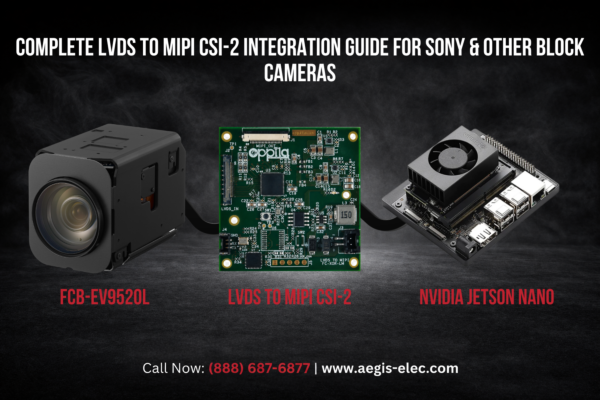
If you’ve tried connecting a Sony FCB-EV9520L (FCBEV9520L) to a modern embedded platform, you’ve probably run into the same issue:
The camera is excellent.
The AI platform is powerful.
But they don’t speak the same interface.
That’s exactly where integration becomes the real challenge—and where the right hardware makes all the difference.
The FCB-EV9520L Integration Problem (and Why It Exists)
The Sony FCB-EV9520L is a professional-grade block camera built for:
- Long-range 30x optical zoom
- Low-light imaging (STARVIS 2)
- Stable, high-quality video output
But like most Sony FCB block cameras, it outputs LVDS.
Meanwhile, platforms like:
- Jetson Orin Nano Super Developer Kit
- Raspberry Pi 5
are designed for MIPI CSI-2 camera input.
So without proper integration, you’re stuck:
- Adding USB or HDMI converters (adds latency)
- Losing direct access to AI pipelines
- Or abandoning a high-performance camera altogether
FCB-EV9520L to NVIDIA Jetson (MIPI CSI-2 Integration Explained)
To connect the FCB-EV9520L to NVIDIA Jetson, you need a clean interface bridge.
This is where an LVDS to MIPI CSI-2 bridge board becomes critical.
Integration Pipeline:
This enables:
- Direct MIPI CSI-2 connection to Jetson
- Low-latency video pipeline
- Full GPU acceleration for AI workloads
Why This Matters for Jetson Systems
Jetson platforms from NVIDIA are built around MIPI CSI-2 because it provides:
- Direct camera-to-GPU pipeline
- Minimal latency (critical for AI)
- High bandwidth (multi-lane MIPI CSI-2)
- Better synchronization for machine vision
This makes FCB-EV9520L to NVIDIA integration via MIPI CSI-2 the optimal solution
FCB-EV9520L to Raspberry Pi 5 Integration
The same concept applies when integrating the FCB-EV9520L to Raspberry Pi 5.
Raspberry Pi 5 also uses MIPI CSI-2 camera input, meaning:
Benefits on Raspberry Pi 5:
- Clean CSI camera interface
- Lower latency vs USB capture
- Better performance for embedded vision
- Ideal for prototyping and lightweight AI
This makes the Sony FCB-EV9520L to MIPI CSI-2 NVIDIA and Raspberry Pi 5 interface a unified solution across platforms.
What the Bridge Board Actually Does
The LVDS to MIPI CSI-2 bridge board:
- Converts LVDS → 4-lane MIPI CSI-2
- Maintains Full HD 1080p @ 60fps
- Preserves signal integrity
- Enables real-time AI processing
Control Integration (Huge Advantage)
Through an onboard I²C-to-UART bridge:
- VISCA control works directly from Jetson or Pi
- Zoom, focus, exposure are fully controllable
- No external serial adapters required
One connection handles both video + control
Why Not Use USB or HDMI Instead?
You can—but it comes with tradeoffs.
| Interface | Latency | AI Performance | Integration |
|---|---|---|---|
| USB 3.0 | Low | Lower | Easy |
| HDMI | Low | Medium | Requires capture |
| MIPI CSI-2 | Very Low | Highest | Native |
MIPI CSI-2 is the only option that gives you true embedded AI performance
Where FC-BEV9520L + MIPI CSI-2 Integration Really Shines
Once integrated correctly, the system unlocks:
AI Edge Computing
Real-time inference directly from optical zoom data
Robotics & Autonomous Systems
Low latency = faster decisions
UAV / Drone Vision
Lightweight + long-range imaging
Medical/Machine Vision
Use proven Sony optics instead of limited USB cameras
Security & Surveillance
Combine zoom cameras with AI analytics
One Camera, Multiple System Possibilities
One of the biggest advantages of the FCB-EV9520L integration approach is flexibility.
Instead of being locked into one ecosystem, you can deploy across:
- NVIDIA Jetson platforms
- Raspberry Pi systems
- Custom embedded AI platforms
All using the same camera + MIPI CSI-2 pipeline
Additional Compatible Camera Ecosystems (Footnote for Flexibility)
While this guide focuses on the Sony FCB-EV9520L, the same LVDS to MIPI CSI-2 approach applies to:
- Sony FCB-EV9500L and other FCB models
- Tamron LVDS block cameras
- Wonwoo block cameras
- KT&C LVDS cameras
Any camera using the Sony 30-pin LVDS interface standard
Conclusion: The Right Interface Changes Everything
The challenge isn’t finding a powerful camera or a capable AI platform—it’s getting them to work together efficiently.
By bridging LVDS to MIPI CSI-2, the FCB-EV9520L becomes a fully optimized AI vision camera, capable of:
- Direct Jetson integration
- Raspberry Pi 5 compatibility
- Low-latency embedded processing
- Scalable multi-camera deployment
This approach removes the bottlenecks and lets you build systems the way they were meant to work—from sensor to AI, without compromise.
Talk to a Technical Expert
Talk to a technical expert → [email protected] | (760) 729-2026
With decades of experience in machine vision, surveillance, and embedded AI systems, Aegis Electronic Group helps engineers select the right camera, interface, and processing platform—and get it integrated correctly the first time.