
If you’re still running analog cameras in your system, you’re not alone.
Across security, industrial inspection, transportation, and legacy machine vision, NTSC/PAL CVBS cameras are everywhere. They’re reliable, proven, and already deployed.
But here’s the problem:
Modern AI platforms like NVIDIA Jetson and Raspberry Pi 5 don’t accept analog video directly.
That’s where the NTSC/PAL to MIPI CSI-2 Bridge Board comes in—and why it’s becoming a critical upgrade path for embedded vision systems.
The Analog to AI Gap
Analog cameras output composite video, also known as CVBS, using NTSC or PAL formats.
Modern embedded platforms expect:
- MIPI CSI-2 native camera input
- Digital, synchronized video data
- Low-latency video pipelines
- Direct access for AI processing
Without conversion, you may be stuck with:
- USB capture devices that can add latency
- Encoders or IP streaming that add complexity
- Full camera replacement, which can be expensive
That’s not always scalable.
What the NTSC/PAL to MIPI CSI-2 Bridge Board Actually Does
This board provides a cleaner path from analog video to embedded AI processing:
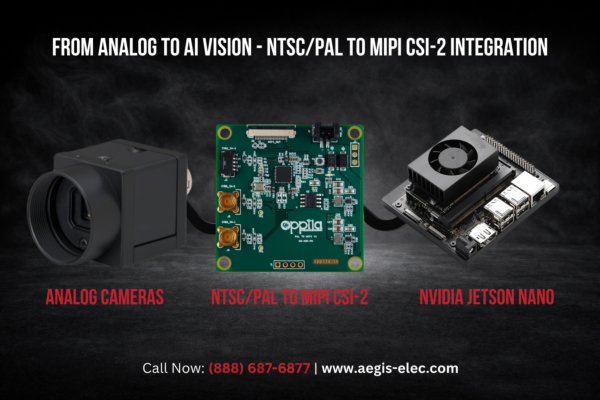
Analog Camera / CVBS → NTSC/PAL to MIPI CSI-2 Bridge Board → Jetson / Raspberry Pi 5
Inside the pipeline, the analog camera outputs NTSC or PAL video, the bridge board digitizes the CVBS signal, converts it into MIPI CSI-2, and sends the video into the embedded platform for real-time processing.
Why MIPI CSI-2 Matters for AI Vision Systems
Using MIPI CSI-2 instead of USB capture or external encoding can offer several advantages for embedded vision applications:
- Lower latency for robotics and AI vision
- Direct camera input for platforms such as NVIDIA Jetson
- Better embedded system efficiency
- Cleaner hardware integration
- Improved path for real-time inference and image processing
This is especially important for:
- Real-time inference
- Motion tracking
- Autonomous systems
- Industrial inspection
- Surveillance modernization
Built for NVIDIA Jetson & Raspberry Pi 5 Integration
This isn’t a generic analog converter. It is designed for embedded vision and AI camera workflows where analog CVBS video needs to be brought into a MIPI CSI-2-based platform.
Compatible platform examples may include:
- Jetson Orin Nano Super Developer Kit
- Jetson Orin Nano 4GB / 8GB
- Jetson Orin NX
- Jetson AGX Orin
- Raspberry Pi 5
- AVerMedia D133
- Waveshare Jetson IO Base
What this enables:
- Direct MIPI CSI-2 camera input
- Real-time AI video processing
- Cleaner embedded system design
- Easier legacy camera upgrades
Compatible Analog Cameras: Real-World Examples
This is where the board becomes powerful. In many cases, you may not need to replace your existing cameras if they output standard NTSC/PAL CVBS composite video.
Supported camera types may include:
- NTSC composite cameras
- PAL composite cameras
- Legacy CCTV cameras
- Industrial analog inspection cameras
- Board-level CVBS cameras
- Select broadcast composite video sources
Example compatible camera families may include:
Omron / Sentech TV Format Cameras
KT&C Analog Cameras
- KPC-C700NU 850TVL
- KTC-MB1902xWX / MB2302xWX when configured for CVBS output
- KTC-MS2502xB / MS3002xB when configured for CVBS output
Sony Analog Cameras
Other Legacy Analog Systems
- Select Hitachi analog cameras
- Select Watec low-light analog cameras
- Compatible Videology NTSC/PAL board cameras
If the camera outputs standard NTSC/PAL CVBS composite video, it may be a strong candidate for integration, depending on connector, signal format, and board configuration.
Important note: HD analog formats such as TVI, AHD, CVI, EX-SDI, Y/C, and non-standard progressive-scan outputs may require a different bridge solution or additional conversion. Always confirm the camera’s active output mode before integration.
Where This Board Really Shines
Once you remove the interface barrier, you unlock new use cases for legacy analog cameras.
AI Edge Upgrades
Modernize existing camera systems without replacing every deployed camera.
Robotics & Autonomous Systems
Low-latency camera input can help improve real-time decision-making.
Industrial Retrofits
Upgrade inspection systems while preserving validated camera hardware.
Surveillance Modernization
Add AI analytics to existing CCTV and analog video infrastructure.
UAV / ROV Systems
Reuse lightweight analog payload cameras in embedded vision workflows.
Why Not Just Use USB Capture?
USB capture can work in some cases, but it is not always ideal for embedded AI systems.
| Method | Common Drawbacks |
|---|---|
| USB Capture | Added latency, CPU overhead, less direct embedded integration |
| IP / Encoder | More complex setup, possible network delay, added processing layer |
| Full Camera Replacement | Higher cost, redesign time, system validation required |
| MIPI CSI-2 Bridge | Cleaner embedded architecture, lower-latency path, direct camera interface |
The Bigger Picture: Legacy Infrastructure Meets AI
Most teams don’t start from scratch.
They already have:
- Cameras deployed
- Systems validated
- Hardware in the field
- Existing cables, housings, and installation work
The NTSC/PAL to MIPI CSI-2 Bridge Board allows teams to extend system lifespan, reduce upgrade costs, and introduce AI processing without fully replacing legacy camera infrastructure.
Quick Integration Summary
System Flow:
Analog Camera → CVBS → NTSC/PAL to MIPI CSI-2 Bridge Board → MIPI CSI-2 → Jetson / Raspberry Pi → AI Processing
Final Thoughts
If you’re working with standard NTSC/PAL CVBS cameras and want to move into AI vision systems, this board can provide a practical upgrade path.
It helps remove one of the biggest barriers between legacy video infrastructure and modern embedded AI platforms, allowing engineers to build faster, cleaner, and more scalable vision systems without automatically replacing every camera in the field.
Talk to a Technical Expert
[email protected] | (760) 729-2026
With decades of experience in machine vision, surveillance, and embedded systems, Aegis helps engineers upgrade legacy camera systems and integrate them into modern AI platforms—the right way, the first time.