
If you’ve tried integrating the Sony FCB-ER8530 (FCBER8530) into an embedded AI system, you’ve probably run into the same issue:
The camera delivers stunning 4K video.
The AI platform is powerful.
But the interface doesn’t match.
That gap between HDMI/4K output and MIPI CSI-2 input is where most integration problems begin—and where the right approach makes all the difference. This same challenge also applies to other block cameras using HDMI or 4K video output.
The FCB-ER8530 Integration Challenge
The Sony FCB-ER8530 is a compact 4K block camera built for:
UHD 3840 × 2160 imaging
20x optical zoom
Industrial and OEM deployments
Robotics, UAV, and surveillance systems
But unlike LVDS-based FCB models, the FCB-ER8530 outputs HDMI video.
Meanwhile, platforms like:
Jetson Orin Nano Super Developer Kit
Raspberry Pi 5
are designed for MIPI CSI-2 camera input.
So without proper conversion, you’re forced into:
USB capture devices
Network streaming (IP cameras)
Increased latency and complexity
FCB-ER8530 to NVIDIA Jetson Orin Nano MIPI CSI-2 Integration Explained
To properly connect the FCB-ER8530 to NVIDIA Jetson, you need a clean conversion path from HDMI/4K to MIPI CSI-2.
Integration Pipeline:
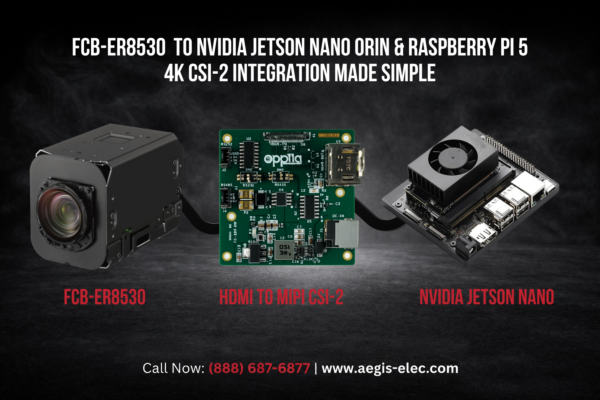
FCB-ER8530 → HDMI/4K → MIPI CSI-2 Bridge → Jetson → AI Processing
This allows:
Direct MIPI CSI-2 camera input into Jetson
Low-latency video processing
Full GPU acceleration for AI workloads
Why MIPI CSI-2 Matters on Jetson
Jetson systems from NVIDIA are optimized for MIPI CSI-2 because it provides:
Direct camera-to-GPU pipeline
Lower latency than USB or HDMI capture
Higher bandwidth efficiency
Better synchronization for machine vision
This makes FCB-ER8530 to NVIDIA integration via MIPI CSI-2 the optimal architecture.
FCB-ER8530 to Raspberry Pi 5 Integration
The same approach applies when connecting the FCB-ER8530 to Raspberry Pi 5.
FCB-ER8530 → HDMI/4K → MIPI CSI-2 Bridge → Raspberry Pi 5
Benefits on Raspberry Pi 5:
Native CSI camera interface
Reduced latency vs USB capture
Better performance for embedded vision
Ideal for development and prototyping
This creates a unified solution for:
Sony FCB-ER8530 to MIPI CSI-2 NVIDIA and Raspberry Pi 5 Interface
What the HDMI/4K to MIPI CSI-2 Bridge Actually Does
The bridge board handles:
HDMI → MIPI CSI-2 conversion
Up to 4K video, camera dependent
Signal conditioning for stable transmission
Low-latency video pipeline
This makes the same type of bridge solution useful not only for the FCB-ER8530, but also for other HDMI or 4K block cameras that need to interface with embedded MIPI CSI-2 platforms.
Control Integration
In addition to video, the system supports:
VISCA camera control, including zoom, focus, and exposure
UART-based communication
Integration directly from Jetson or Pi
One pipeline handles both video + control.
Why Not Just Use HDMI or USB Directly?
While possible, it introduces tradeoffs:
| Interface | Latency | AI Performance | Integration |
|---|---|---|---|
| USB Capture | Moderate–High | Lower | Easy |
| HDMI Capture | Moderate | Medium | Requires extra hardware |
| MIPI CSI-2 | Very Low | Highest | Native to Jetson/Pi |
MIPI CSI-2 is the only interface optimized for real-time AI vision systems.
Where FCB-ER8530 Integration Really Excels
Once integrated correctly, the system unlocks:
4K AI Edge Computing
High-resolution data directly into AI pipelines.
Robotics & Autonomous Systems
Improved decision-making with low-latency input.
UAV / Drone Vision
Compact 4K zoom camera for aerial imaging.
Industrial Machine Vision
Reliable UHD imaging for inspection systems.
Security & Surveillance
Long-range 4K monitoring with AI analytics.
Clean System Architecture: No Workarounds Required
Instead of building around limitations, this approach creates:
Direct camera → processor pipeline
No USB bottlenecks
No external capture cards
Scalable multi-camera design
This is how modern embedded vision systems are built.
Flexible Integration Across Platforms
One of the biggest advantages of this approach is flexibility.
The FCB-ER8530 integration model works across:
NVIDIA Jetson platforms
Raspberry Pi 5
Custom embedded AI systems
Same camera, same workflow, multiple deployment options.
Additional Compatible Camera Ecosystems
While this guide focuses on the Sony FCB-ER8530, the same MIPI CSI-2 integration approach applies to:
Sony FCB-ER9500, 4K HDMI
Sony FCB-EW9500H, 4K HDMI
Other HDMI-based block cameras
Tamron and OEM HDMI camera systems
Any compatible block camera using HDMI or 4K video output
Any camera with HDMI output can be integrated using MIPI CSI-2 bridge solutions.
Conclusion: Unlocking 4K AI Vision Without Compromise
The challenge isn’t choosing a camera or a platform—it’s making them work together efficiently.
By converting HDMI to MIPI CSI-2, the FCB-ER8530 becomes a fully optimized AI vision camera, capable of:
Direct Jetson integration
Raspberry Pi 5 compatibility
Low-latency 4K processing
Scalable embedded system design
The same integration path can also support other HDMI and 4K block camera systems where a clean MIPI CSI-2 connection is required.
This approach eliminates the typical bottlenecks and allows you to build true high-performance AI vision systems—from sensor to inference—without compromise.
Talk to a Technical Expert
[email protected] | (760) 729-2026
With decades of experience in machine vision, surveillance, and embedded AI systems, Aegis Electronic Group helps engineers select the right camera, interface, and processing platform—and get it integrated correctly the first time.