
Sony FCB-ER9500 4K60P 25x Zoom Block Camera | STARVIS 2 IMX678 | HDMI Output
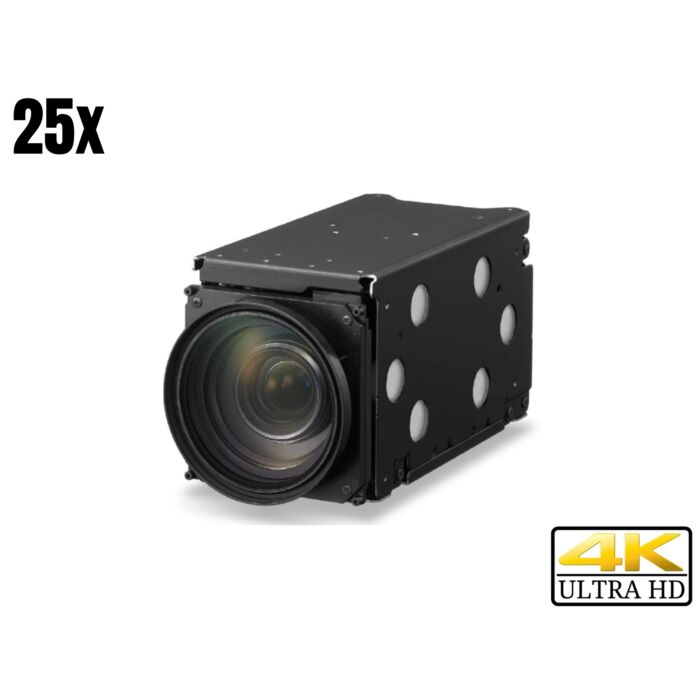
- Resolution: 4K60P (3840 x 2160)
- Sensor: Sony IMX678 STARVIS™2 CMOS, 1/1.8-type, 8.4MP
- Optical Zoom: 25x zoom lens, F1.6 to F4.8
- Field of View: 59.0° wide to 2.8° tele
- Low Light Performance: Minimum illumination down to 0.028 lux
- Video Output: HDMI digital output up to 4K60P
- Control Interface: VISCA protocol
- Compliance: NDAA compliant
- Operating Temperature: -5°C to +60°C
- Dimensions: 56 × 64 × 125 mm
- Weight: 464 g
- SKU
- FCB-ER9500
The Sony FCB-ER9500 is a high-performance 4K Ultra HD block camera engineered for demanding OEM, industrial, and embedded vision applications. Built around Sony’s IMX678 STARVIS™ 2 CMOS sensor, it delivers 3840 × 2160 resolution at up to 60 frames per second with excellent low-light sensitivity and low-noise image processing.
With its 25x optical zoom lens and wide-to-telephoto range, the FCB-ER9500 enables precise long-distance imaging for inspection, surveillance, robotics, and machine vision systems. The combination of high resolution, advanced image controls, and compact block camera design makes it ideal for integrators requiring reliable, high-quality imaging in embedded environments.
Integration with Jetson & MIPI CSI-2
The Sony FCB-ER9500 outputs video via HDMI, which can be converted to a native MIPI CSI-2 interface using dedicated bridge boards. This enables seamless integration with platforms such as the Jetson Orin Nano Super Developer Kit.
By converting HDMI video into CSI-2, developers can connect the FCBER9500 directly to Jetson-based systems for low-latency, high-bandwidth video processing. This approach eliminates the need for USB capture devices or IP streaming, providing a more efficient and scalable architecture for embedded AI and computer vision applications.
This configuration is widely used in systems where 4K resolution and real-time AI inference are required, including robotics, UAV imaging, and advanced inspection systems.
Sony FCB-ER9500 CSI-2 Integration Use Cases
The FCB-ER9500 is commonly deployed in CSI-2-based embedded vision systems, including:
- AI vision systems using NVIDIA Jetson platforms
- Robotics and autonomous navigation systems
- UAV and drone-based imaging payloads
- Industrial inspection and quality control
- Defense, security, and surveillance systems
- Medical and research imaging platforms
Key Features:
- 4K Ultra HD resolution (3840 × 2160) at up to 60 fps
- Sony IMX678 STARVIS™ 2 CMOS sensor for superior low-light performance
- 25x optical zoom lens (6.5 mm to 162.5 mm)
- Minimum illumination down to 0.028 lux
- HDMI digital output for high-resolution video transmission
- VISCA control protocol for camera operation
- Wide Dynamic Range, defog, noise reduction, and stabilization
- NDAA compliant for secure deployment
Applications:
- Industrial automation and machine vision
- Robotics and embedded AI systems
- UAV / drone imaging systems
- Government, defense, and surveillance imaging
- Inspection and quality assurance systems
- Remote monitoring and long-range observation
Why Use the FCB-ER9500 with CSI-2 Systems
For high-resolution embedded vision systems, MIPI CSI-2 provides a direct interface into the processing pipeline of modern AI platforms. When paired with an HDMI to MIPI CSI-2 bridge board, the FCB-ER9500 becomes a powerful imaging solution for Jetson-based systems.
This enables:
- Direct GPU access for 4K video processing
- Lower latency compared to USB or network streaming
- High-bandwidth CSI-2 video transfer
- Simplified system architecture for embedded integration
| Model | FCB-ER9500 |
| Image Sensor | 1/1.8-type IMX678 STARVIS™2 CMOS Progressive scan CMOS image sensor (Approx. 8.40M pixels) |
| Number of Total Pixels (H) x(V) | 3856 x 2200, 8.48M [pixels] |
| Number of Effective Pixels (H) x(V) | 3856 x 2180, 8.40M [pixels] |
| Number of Recommended Recording Pixels (H) x(V) | 3840 x 2160, 8.29M [pixels] |
| Magnification | 25[times] |
| Angle of View [degree] | Horizontal: Approx. 59.0 (Wide), Approx. 2.8 (Tele) Vertical:Approx. 35.0 (Wide), Approx. 1.5 (Tele) Diagonal:Approx. 65.0 (Wide), Approx. 3.2 (Tele) |
| F Value | F1.6 (Wide) to F4.8 (Tele) |
| Zoom Motor | Stepping motor |
| Focus Motor | Stepping motor |
| Iris | Stepping motor |
| IRCF | Meter Galvano method |
| Output Image Size (H x V) | 3840 × 2160, 1920 × 1080, 1280 × 720 |
| Output Mode | [4K]2160p/60, 2160p/59.94, 2160p/50, 2160p/30, 2160p/29.97, 2160p/25 [FHD]1080p/60,1080p/59.94,1080i/60,1080i/59.94,1080p/50,1080i/50,1080p/30,1080p/29.97,1 080p/25 [HD]720p/60, 720p/59.94, 720p/50, 720p/30, 720p/29.97,720p/25 [SD]*1 480p/60, 480p/59.94, 576p/50 *1 Test mode |
| Synchronized Codes | [4K] Comparable to CEA861-F [FHD] Progressive - Comparable to CEA861-D [HD] Interlace - Comparable to CEA861-D |
| Minimum Illumination | 50 [IRE], ICR OFF, IRIS OPEN, AGC MAX(28[Step]) Hi Sens ON 0.028[lx] |
| Recommended Illumination | 100 lx to 100,000 lx |
| Image S/N | 50 dB (Weight On) |
| Gain | Auto/Manual (0 dB to 50.0 dB), 0 to 28 steps |
| Shutter Speed | 1/1 to 1/10000 s, 22 steps |
| Sync System | Internal |
| Exposure Control | 0 dB to ± 10.5 dB, 15 steps |
| Backlight Compensation | Yes |
| Gamma | Standard / Straight gamma |
| Aperture Control | 16 steps |
| White Balance | Auto, ATW, Indoor, Outdoor, One Push WB, Manual WB, Outdoor Auto, Sodium Vapor Lamp (Fix/Auto/Outdoor Auto), Spot AWB |
| AE (Auto Exposure Mode) | Full Auto, Manual, Priority mode (shutter/iris), EV compensation, Spot AE, Slow AE |
| Zoom | 25x Optical Zoom, 30x StableZoom*1, 12x Digital Zoom |
| Lens (wide to tele) | 25x Optical Zoom Lens f = 6.5 mm to 162.5 mm, F1.6 to 4.8 |
| Zoom Mode | Standard Mode / Variable Mode / Direct Mode |
| Focusing System | Auto Focus (Normal AF, Interval AF, Zoom Trigger), AF Sensitivity (normal, low), Manual (Standard, Variable, Direct), One Push Trigger, Full Scan One Push Trigger, Near Limit, ICR-on Correction, Spot Focus |
| Minimum Object Distance (wide end to tele end) | 100 mm to 1200 mm |
| Auto ICR | Yes:ON (B&W / Color) |
| Wide Dynamic Range (Wide-D) | Yes |
| Visibility Enhancer | Yes |
| Defog | Yes (low/mid/high) |
| Noise Reduction | Yes (3D + 2D / Independent setting (3D, 2D)) |
| Image Stabilization | Yes: Super image stabilizer (Super / Super+) |
| Spot Light Avoidance | Yes |
| Motion Detection | Yes |
| Privacy Zone Masking | Yes |
| Alarm | Yes |
| Slow AE Response | Yes |
| Picture Effects | Monochrome |
| Electronic-Flip (E-FLIP) | Yes |
| Mirror Image | Yes |
| Slow Shutter | Yes |
| Temperature Readout | Yes |
| Title Display | Yes (20 characters / line, max. 11 lines) |
| Camera Mode Display | Yes (English) |
| Video Output | Digital HDMI output: Y/Pb/Pr 4:2:2, 8-bit and RGB 4:4:4, 8-bit |
| Camera Control Interface | VISCA protocol (CMOS 3.3V Level, 5.5V tolerance); Baud Rate : 9.6 kbps, 19.2 kbps, 38.4 kbps, 115.2 kbps, Stop bit: 1 bit |
| Image Signal Output | Compliant with TMDS(2160p,1080p,1080i,720p) |
| Power Supply | 7.0 V to 12.0 V DC |
| Power Consumption | Approx. 5.8 W (Typ. DC IN 7-12V, zoom/focus inactive)) |
| Operating Temperature | -5 °C to +60 °C (23 °F to +140 °F) |
| Storage Temperature | -20 °C to +60 °C (–4 °F to +140 °F) |
| Operating Humidity | 20% to 80% (Absolute humidity: 36 g/m3) |
| Storage Humidity | 20% to 95% (Absolute humidity: 36 g/m3) |
| Dimensions (W × H × D) | 56 × 64 × 125 mm (2 1/4 × 2 5/8 × 5 in.) |
| Mass | 464 g |
